Table of Content
The most important thing isn’t how much money you earn, but rather, that your income meets a few key requirements. The most recognized 3.5% down payment mortgage in the country. Many people wonder whether they should buy a house or wait and continue to rent. Certain advantages come with renting, and waiting can give you time to improve your credit or save up for a down payment.

With a FHA loan, your debt-to-income limits are typically based on a 31/43 rule of affordability. This means your monthly payments should be no more than 31% of your pre-tax income, and your monthly debts should be less than 43% of your pre-tax income. However, these limits can be higher under certain circumstances. To do this, the calculator considers your mortgage rate, down payment, length of the loan, closing costs, property taxes, homeowners' insurance, points you want to pay and more. You don't need to input all information to receive a ballpark figure. With a total monthly payment of $500 every month for a loan term of 20 years and an interest rate of 4%, you can get a mortgage worth $72,553.
$500 Monthly Payment Breakdown
Refinance your existing mortgage to lower your monthly payments, pay off your loan sooner, or access cash for a large purchase. Use our home value estimator to estimate the current value of your home. See our current refinance ratesand compare refinance options. Using a percentage of your income can help determine how much house you can afford. For example, the 28/36 rule may help you decide how much to spend on a home. The rule states that your mortgage should be no more than 28 percent of your total monthly gross income and no more than 36 percent of your total debt.
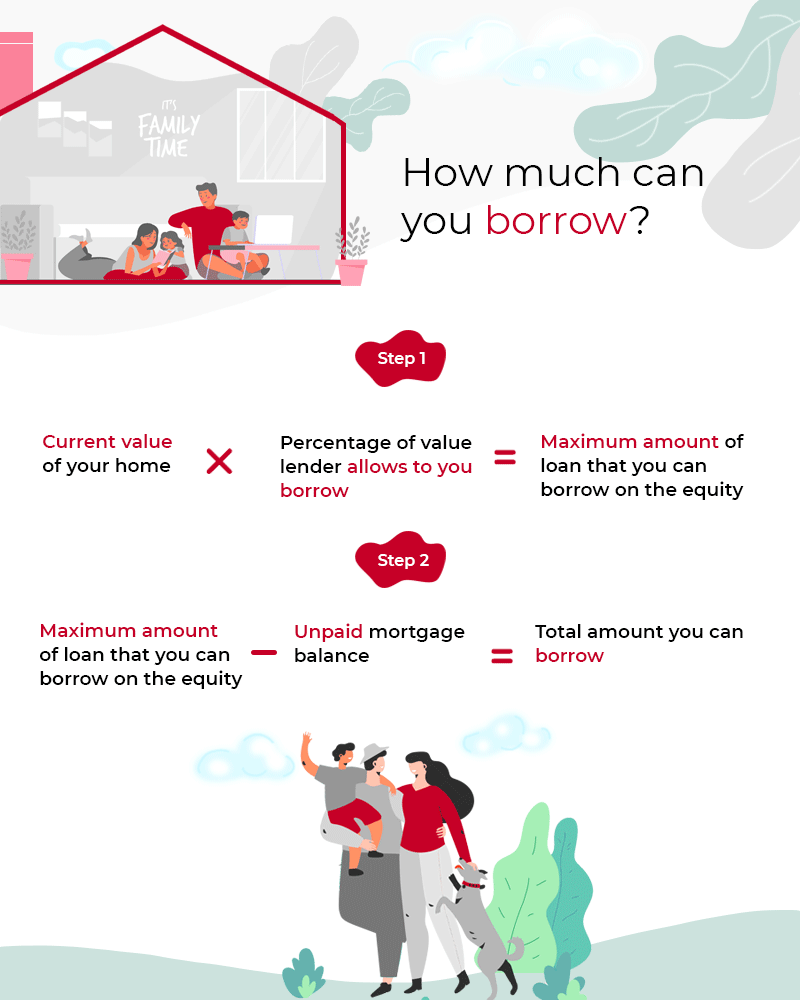
Since your credit score is a major factor in your ability to get a home loan, it’s worth your time and effort to improve it. To do so, pay all of your bills on time as even one late or missed payment can ding your score. Also, catch up on any past-due accounts and make payments on any revolving accounts like credit cards and lines of credit. The mortgage pre-qualifying process is an informal assessment of your ability to repay a loan.
Required Income Calculator for a Mortgage Calculator
The longer term will provide a more affordable monthly payment, but you’ll pay a lot more interest over the long term. A 15-year fixed-rate mortgage will cost you way less interest over the life of the loan, but your monthly payment will be considerably more. Learn more about the line items in our calculator to determine your ideal housing budget. Assuming a loan term of 30 years with an interest rate of 5%, you may qualify for a home up to $74,066 and have a monthly payment of $467.

This shows how much money you have “left over” each month for a mortgage payment. Next, list your estimated housing costs and your total down payment. Include annual property tax, homeowners insurance costs, estimated mortgage interest rate and the loan terms . The popular choice is 30 years, but some borrowers opt for shorter loan terms.
How Much Can I Borrow?
A $250,000 home, with a 5% interest rate for 30 years and $12,500 (5%) down requires an annual income of $65,310. We're not including monthly liabilities in estimating the income you need for a $325,000 home. To include liabilities and determine what you can afford, use the calculator above.

Get pre-approved with a lender today for exact numbers on what you can afford. Make a mortgage payment, get info on your escrow, submit an insurance claim, request a payoff quote or sign in to your account. Go to Chase home equity services to manage your home equity account. This home affordability calculator provides a simple answer to the question, “How much house can I afford? ” But like any estimate, it’s based on some rounded numbers and rules of thumb.
Then work down the page entering your other information and the calculator will figure out the other two values for you and display them in gray. Pre-approval is the next step that thoroughly evaluates your creditworthiness. This can take a few days to a couple of months, depending on the strength of your credit profile and whether you have complete documents. Applicants with low credit scores or history of missed debt payments take longer to obtain pre-approval.

To avoid PMI, try to save 20% of the home’s price, which is $61,038.6. To cover your closing costs, you must save an additional 2% to 5% of your loan amount. If your closing cost is 2% of your loan, you should save an added $5,054.40.
Your lender or mortgage broker may ask you to provide recent financial statements from bank accounts or investments. This will help them determine if you have the down payment. Ultimately, its up to the mortgage lender to decide how much of mortgage you qualify for with the FHA loan program. The official guidelines for this program come from the Department of Housing and Urban Development .

They can be either fixed, staying the same for the mortgage term or variable, fluctuating with a reference interest rate. A lump-sum payment is when you make a one-time payment toward your mortgage, in addition to your regular payments. How much of a lump sum payment you can make without penalty depends on the original mortgage principal amount. In that case, your lender will likely use your average monthly income over the past two years. But if you earned significantly more in one year than the other, the lender may opt for the year's average with lower earnings. Mortgage lenders tend to have a more conservative notion of what's affordable than borrowers do.




No comments:
Post a Comment